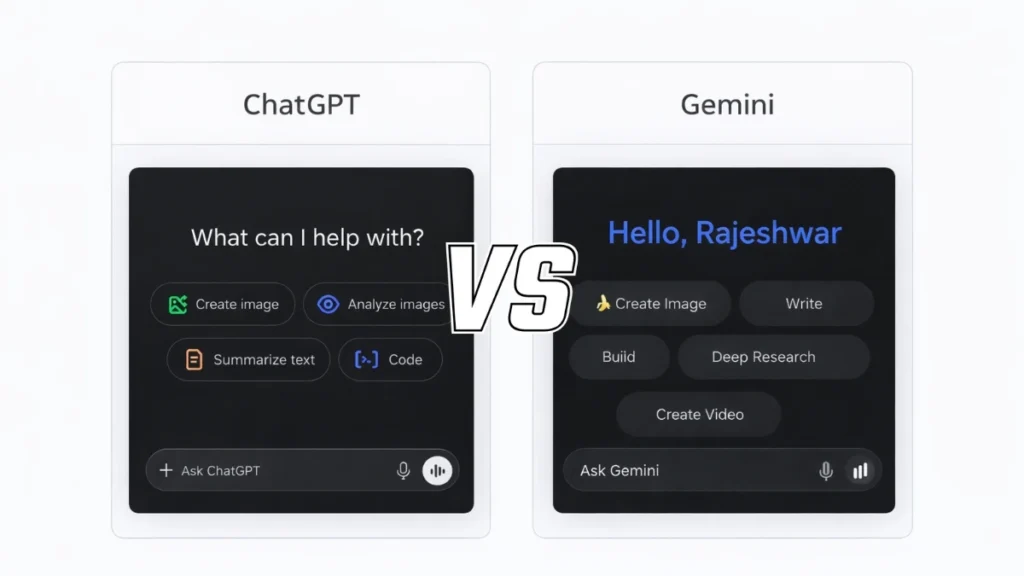

Every time OpenAI or Google drops a new update, the same argument starts all over again. ChatGPT fans say it is miles ahead. Gemini users say Google has finally caught up. And anyone sitting in the middle just wants a straight answer without reading eight different articles to find it.
Most comparisons get this wrong by treating both tools like they are competing for the same job. They are not. ChatGPT was built for flexibility across any workflow. Gemini was built to disappear inside tools you already use every day. That difference sounds small on paper. In daily use, it changes everything.
I went through both tools carefully, cross-referenced independent testing from multiple sources, and pulled every pricing figure from official pages. Here is the honest breakdown about ChatGPT vs Gemini.
Quick Facts Table
| Feature | ChatGPT | Gemini |
|---|---|---|
| Developer | OpenAI | |
| Current Model | GPT-5.2 | Gemini 3.1 Pro |
| Free Plan | Yes, limited messages | Yes, more generous limits |
| Entry Paid Plan | $8/month (Go) | $19.99/month (AI Pro) |
| Mid Tier | $20/month (Plus) | $19.99/month (AI Pro) |
| Top Tier | $200/month (Pro) | $249.99/month (AI Ultra) |
| Real-Time Web | Paid plans only | Free and paid plans |
| Google Apps Integration | No | Deep native integration |
| Context Window | 128K tokens | 1 million tokens |
| Ads on Free Plan | Yes | No |
ChatGPT in 2026: Built for People Who Work Across Everything
ChatGPT runs on GPT-5.2 right now, and the difference from GPT-4 is not subtle. Reasoning is sharper. Tasks that used to need three careful follow-up prompts now land correctly on the first attempt more often than not. During independent testing, ChatGPT scored a perfect 100% on AIME 2025 advanced math and 80% on SWE-Bench Verified, showing strong performance on both analytical and coding benchmarks.
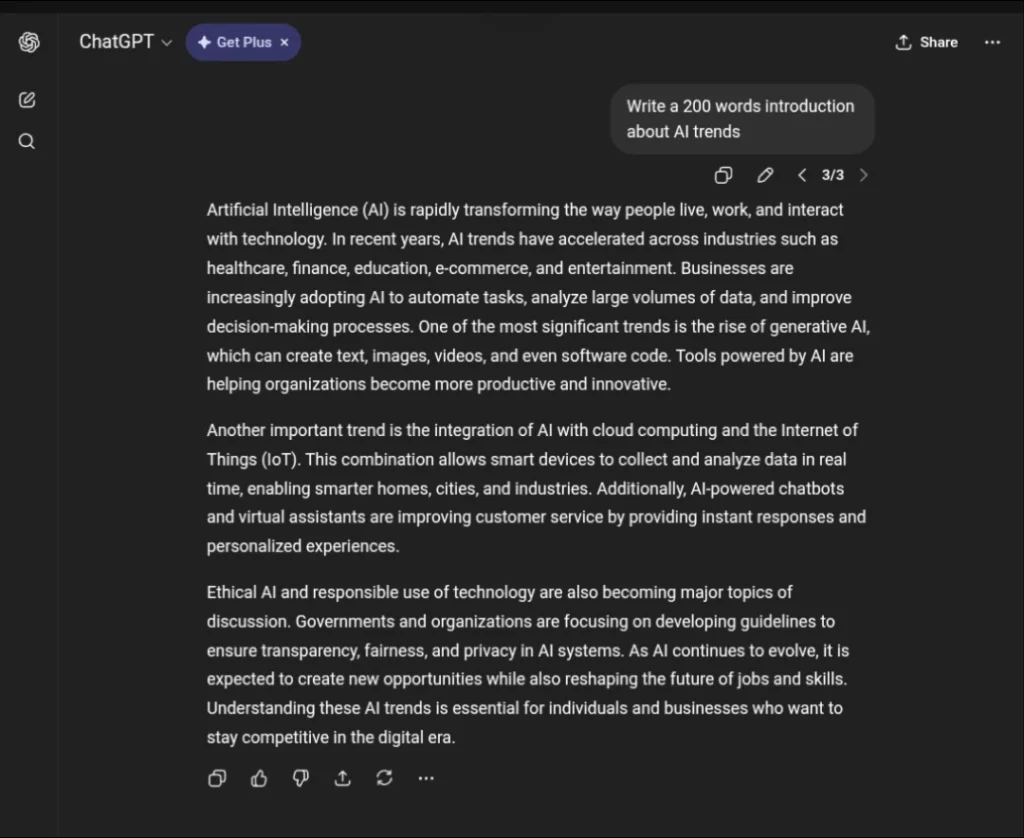
What I find most valuable about ChatGPT is its breadth. A freelance writer uses it to structure a long article. A developer uses it to debug code. A small business owner uses it to draft six months of email content in one afternoon. The same tool handles all three without being specifically built for any of them. That range across completely different workflows is genuinely rare in a single product.
The third-party integration ecosystem adds another layer of value. Through custom GPTs and API connections, you can attach tools like Notion, Canva, Slack, and HubSpot. For anyone whose work spans multiple platforms outside Google’s world, this is where ChatGPT builds a real practical lead.
One thing worth flagging: OpenAI introduced ads in the free tier and Go plan in 2026. If you use the free version regularly, you will start seeing them. All paid plans from Plus onwards remain completely ad-free.
Gemini in 2026: The Smarter Choice If Google Is Your World
Gemini had a rough start. The first public demo had a factual error. The Bard branding confused people. For most of 2023, it felt like Google was reacting to ChatGPT rather than building something with its own identity.
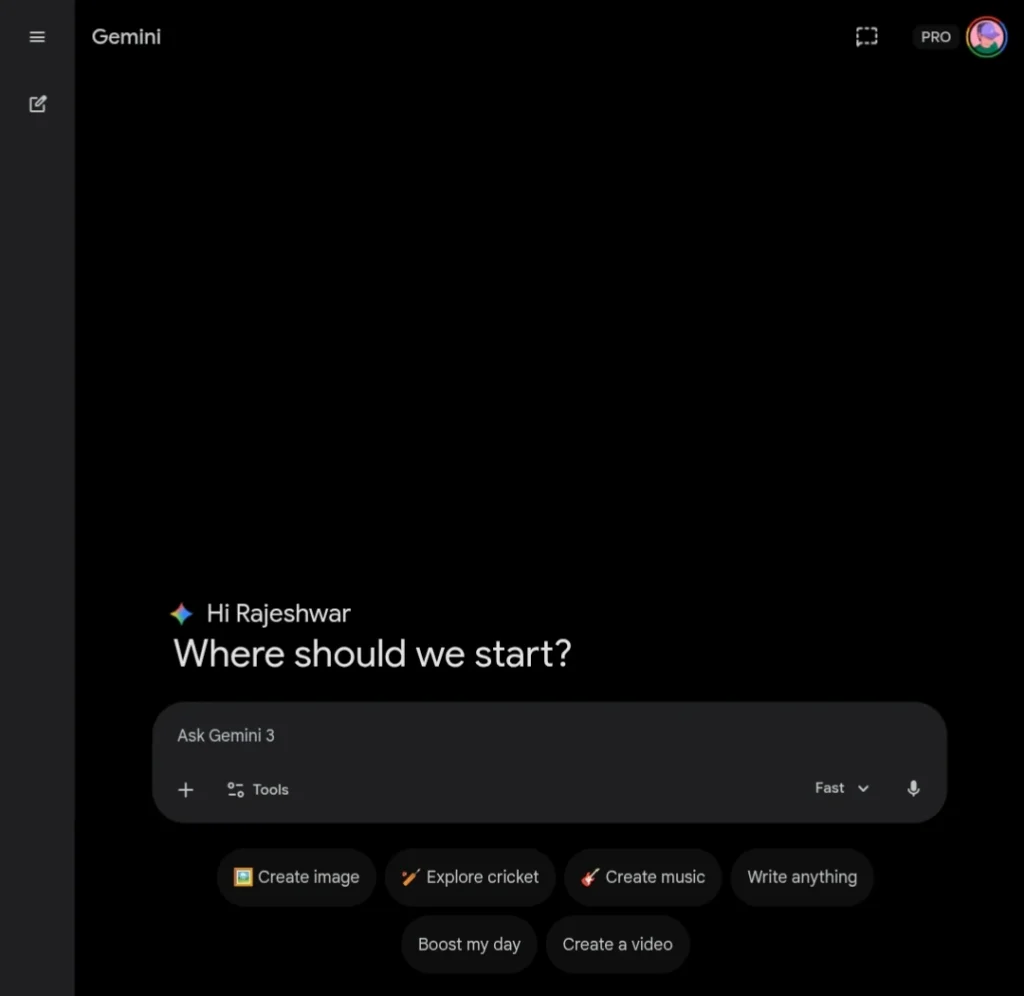
That version of Gemini no longer exists.
With the release of Gemini 3 in November 2025, Google redefined its multimodal and reasoning capabilities, raising the bar significantly for the whole AI assistant space. The model handles text, images, audio, and video natively. But what makes Gemini genuinely different from every competitor is not the model itself. It is what Google built around it.
Gemini is now wired directly into Gmail, Drive, Docs, Sheets, Meet, and Chrome at a level that feels native rather than added on. Ask it to pull the most important emails from last week, summarize a Drive document you have not opened since January, and draft a reply in your usual tone. During meetings, Gemini summarizes notes, identifies key decisions, and suggests next-step actions directly in Docs. In Gmail, it drafts context-aware responses, and in Sheets, it automates data interpretation. All of that without switching a single tab.
ChatGPT physically cannot do this. Not because the model is weaker, but because Google’s infrastructure is not available to any outside company. For anyone who spends most of their working day inside Google’s tools, that gap matters far more than any benchmark score.
ChatGPT vs Gemini AI: Where Each Tool Wins and Loses
Writing Quality
Long-form structured writing is still ChatGPT’s clearest advantage. Blog posts, research summaries, detailed guides: anything requiring consistent tone and argument across several hundred words tends to come out more coherent from ChatGPT. ChatGPT wins for quality, creativity, and tone control. Gemini wins for speed-to-draft and integration with Google Workspace.
For short, factual, current-events content, Gemini’s real-time Google Search grounding makes it faster and more accurate. I would reach for Gemini first when I need a quick summary of something that happened in the last 48 hours.
Verdict: ChatGPT for long-form writing. Gemini for short current-events content.
Coding
On SWE-Bench Verified, GPT-5.2 scores approximately 80% while Gemini 3.1 Pro hits 80.6%. The difference is statistically negligible for most practical coding tasks. Both tools handle everyday coding competently.
Where they separate is style. ChatGPT writes cleaner, better-commented code and handles debugging across longer back-and-forth sessions more consistently. Gemini is faster and its 1 million token context window makes it genuinely useful for dropping an entire codebase in and asking architecture questions.
Verdict: ChatGPT for debugging and clean output. Gemini for large codebase analysis.
Real-Time Information
Gemini usually gave faster answers in independent testing, finishing a source-lookup test in around 5 seconds while ChatGPT took closer to 25 seconds. Gemini pulls directly from Google Search, which is a structural advantage for time-sensitive queries that Bing-based access does not fully match. For anything involving current events or recent data, I trust Gemini’s output more on the first try.
Verdict: Gemini wins this one. Not particularly close.
Voice Mode
ChatGPT’s voice mode works across devices, has smoother interruption handling, and maintains a more natural conversational cadence. Gemini’s real-time voice conversation is currently more mobile-first and more restricted. If voice is how you primarily use AI, ChatGPT is the better pick right now.
Verdict: ChatGPT leads on voice right now.
ChatGPT vs Gemini: Full Pricing Comparison
ChatGPT Pricing (Official)
| Plan | Price | What You Get |
|---|---|---|
| Free | $0/month | GPT-5.2, limited daily messages, ads included |
| Go | $8/month | More messages than free, image creation, ads included |
| Plus | $20/month | GPT-5.2 full access, 25 deep research reports, image gen, no ads |
| Pro | $200/month | Unlimited all models, priority queue, no ads |
| Team | $25/user/month | Shared workspace, admin controls, no data training |
Gemini Pricing (Official)
| Plan | Price | What You Get |
|---|---|---|
| Free | $0/month | Gemini 3 Flash, real-time web, basic Google app access, no ads |
| AI Pro | $19.99/month | Gemini 3.1 Pro, 2TB storage, full Gmail and Docs AI, Deep Research |
| AI Ultra | $249.99/month | Highest model, 30TB storage, Veo 3 video generation, YouTube Premium |
ChatGPT vs Gemini: Direct Tier-by-Tier Comparison
| What You Compare | ChatGPT | Gemini | Better Value |
|---|---|---|---|
| Free plan daily limits | Fewer messages, ads | More conversations, no ads | Gemini |
| Budget paid option | Go at $8/month | No equivalent tier | ChatGPT |
| Mid tier ($20) | Plus: GPT-5.2, deep research, image gen | AI Pro: 2TB storage, Gmail+Docs AI | Gemini for Google users |
| Storage included | None on any plan | 2TB on Pro, 30TB on Ultra | Gemini |
| Top individual tier | Pro at $200/month | Ultra at $249.99/month | ChatGPT |
| Ads on free plan | Yes | No | Gemini |
| Third-party integrations | Strong via GPTs | Limited outside Google | ChatGPT |
The $20 tier is where this decision gets interesting for most people. Gemini AI Pro bundles 2TB of cloud storage alongside the AI model. If you already pay Google separately for extra storage, that bundle effectively makes the AI features cost next to nothing on top of what you were spending anyway. ChatGPT Plus gives you a more powerful standalone AI tool with higher feature limits but zero storage or ecosystem bundling. Which matters more depends entirely on how your work is already set up.
Which One Should You Actually Use
Chatgpt vs Gemini: I think the cleanest way to answer this is to skip the general ranking entirely and just ask the right question: where does your work actually live?
Pick ChatGPT if:
- Your tools span multiple platforms outside Google’s ecosystem
- You write long-form content regularly and need reliable tone and structure
- You debug or build code and want cleaner, better-commented output
- You want a versatile standalone AI with strong third-party app connections
Pick Gemini if:
- Gmail, Drive, Docs, and Sheets are open on your screen for most of the day
- You need accurate real-time information for research and current topics
- You want more free daily conversations with no ads
- You already pay for Google One storage and want to consolidate costs
Many professionals in 2026 use both strategically: Gemini for information retrieval and multimodal tasks, and ChatGPT for complex reasoning, creative work, and programming assistance. Running both free plans for one week on your actual tasks costs nothing and tells you more than any comparison article.
Common Mistakes to Avoid
- Picking based on a single test prompt. Test both with five tasks from your actual daily work. One prompt tells you almost nothing about how the tool fits your real workflow.
- Assuming ChatGPT always writes better. It handles long structured content more consistently. For short factual summaries grounded in recent data, Gemini is often faster and more reliable.
- Forgetting the free plan differences. Gemini gives more daily conversations with real-time web and no ads at zero cost. ChatGPT gives a stronger model in smaller doses with ads now included. Those are genuinely different value propositions.
- Ignoring data privacy. Both free consumer plans may use your conversations for model training. For sensitive professional work, the paid business tiers of either platform are the minimum threshold worth considering.
Key Takeaways
- ChatGPT leads on long-form writing, complex coding, third-party integrations, and cross-platform flexibility.
- Gemini leads on Google ecosystem integration, real-time web accuracy, free plan generosity, and bundled value at the $20 paid tier.
- ChatGPT holds over 60% of the standalone AI chatbot market. Gemini has grown from 13% to over 20% market share in one year and continues gaining ground rapidly.
- Both paid plans cost approximately $20 per month, making workflow fit more important than price.
- Gemini’s free plan has no ads. ChatGPT’s free plan now includes them.
Frequently Asked Questions (FAQ)
Q1. Is ChatGPT better or Gemini?
Honestly, neither one wins across the board. It completely depends on what you use AI for daily. From my research, ChatGPT is stronger for long-form writing, complex coding, and working across multiple platforms outside Google’s world. Gemini is stronger for real-time web accuracy, Google ecosystem integration, and free plan generosity. If your work lives inside Gmail and Drive, Gemini fits better. If your work spans multiple tools, ChatGPT is the more complete standalone option. The best approach is testing both free plans on your actual tasks for one week before deciding anything.
Q2. Will Gemini overtake ChatGPT?
It is closing the gap faster than most people expected. ChatGPT currently holds roughly 64 to 68 percent of the AI chatbot market, while Gemini has grown from around 13 percent to over 20 percent market share in just one year. That growth rate is significant. Gemini has one structural advantage that ChatGPT cannot easily replicate: Google’s existing user base of billions across Gmail, Search, Drive, and Android. Every person who already uses Google products is a potential Gemini user without any extra signup. Whether Gemini fully overtakes ChatGPT depends on whether Google continues improving the model quality at the same pace it has shown since Gemini 3 launched.
Q3. Which AI is better than ChatGPT?
No single AI tool beats ChatGPT across every category right now. Different tools lead in specific areas. Gemini beats ChatGPT on real-time web search accuracy and Google ecosystem integration. Claude from Anthropic is widely considered stronger for nuanced long-form writing and following complex instructions carefully. Perplexity AI leads specifically for research-heavy tasks where source citation and real-time accuracy matter most. The honest answer is that “better than ChatGPT” depends entirely on the task. For versatility across mixed workflows, nothing has clearly overtaken it yet.
Q4. What is the real difference between Gemini AI Pro and ChatGPT Plus?
Both cost approximately $20 per month. Gemini AI Pro includes 2TB storage and full native Google Workspace AI integration. ChatGPT Plus gives GPT-5.2 full access, 25 deep research reports, and image generation with no storage or ecosystem bundling.
Q5. Is Gemini completely free?
Yes. Gemini’s free plan includes real-time web search, basic Google app access, and no ads. It is more generous for casual daily use than ChatGPT’s free tier.
..
Conclusion
After going through both tools carefully, the ChatGPT vs Gemini question in 2026 comes back to one honest answer: it depends on where your work actually lives.
If your day runs through Gmail, Drive, and Docs, Gemini removes real friction that no other tool can match at that price. If your work crosses multiple platforms and demands consistent long-form writing or serious coding, ChatGPT remains the more complete standalone option.
Stop reading comparisons and start testing. Both free plans cost nothing. Open both tools this week and use them on something you actually need to get done today. That single session will give you a clearer answer than anything written here.
If this guide helped you decide, share it with someone still stuck in the ChatGPT vs Gemini debate. And if you want more honest AI tool comparisons like this one, bookmark TechSikho.in and check back regularly.
Disclaimer: All pricing and features are based on official sources verified in March 2026. AI products update frequently so always check official websites before subscribing.
Also Read:
- Sam Altman Net Worth 2026: Age, Education & Best AI Coding Advice
- 8 Best AI Tools for Coding in 2026 | Beginner to Pro Guide
- I Tested Google Flow AI for 7 Days | Here’s My Honest Review 2026
- Aravind Srinivas Net Worth 2026: Success Story of India’s Youngest AI Billionaire
- The Complete ChatGPT Photo Editing Prompts That Will Instantly Upgrade Your Photos In 2026