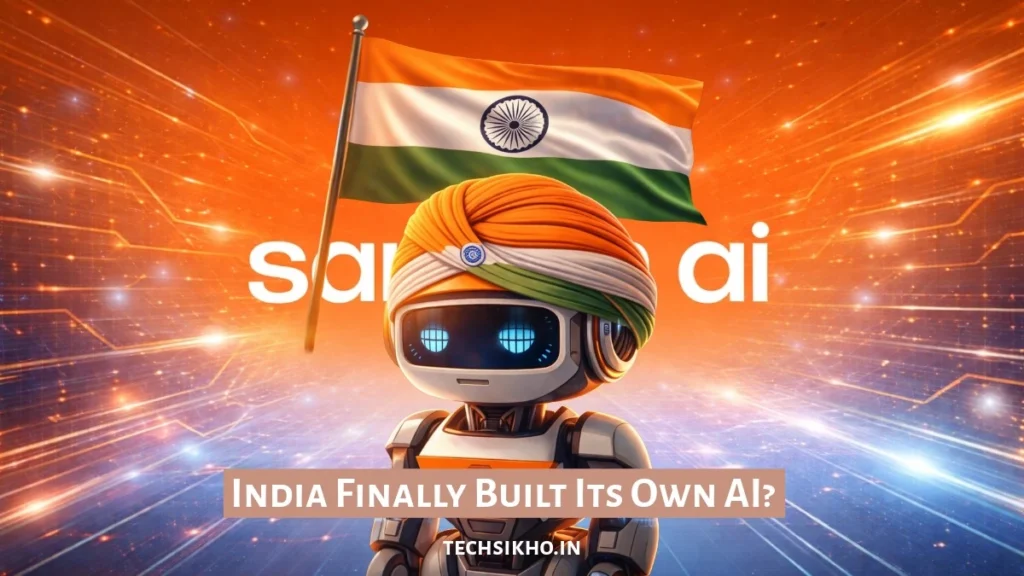

After testing Sarvam AI for a week, I realized it’s not just another chatbot, it’s built for our languages. Every time you type in Hindi and get a stiff, robotic reply from ChatGPT, you are not imagining it. That tool was not built for you. It was built for San Francisco. Sarvam AI is the team that looked at that problem and said, enough — India deserves better than a translation layer dressed up as intelligence.
And here is what makes this story different from every other “India’s ChatGPT” headline you have scrolled past: these people are actually delivering.
What Is Sarvam AI?
Here is something most AI companies would never attempt, throwing away the Western AI playbook entirely and starting from zero for India.
That is exactly what Sarvam AI did. Starting its journey in the tech hub of Bengaluru in 2023, the company is not trying to adapt someone else’s model for Indian languages. They are building large language models that think in Indian languages from the ground up, natively, without translation tricks in the background.
The name says it all. “Sarvam” is a Sanskrit word meaning “everything,” and the mission lives up to that name. This is not AI for the English-speaking top one percent. It is AI for the farmer in UP, the student in Tamil Nadu, and the shopkeeper in Gujarat who has never felt like any tech product was made with them in mind.
Who Built Sarvam AI?
Forget the typical startup founder story. The people behind Sarvam AI were not chasing a trend they were already deep in the work before anyone called it a trend.
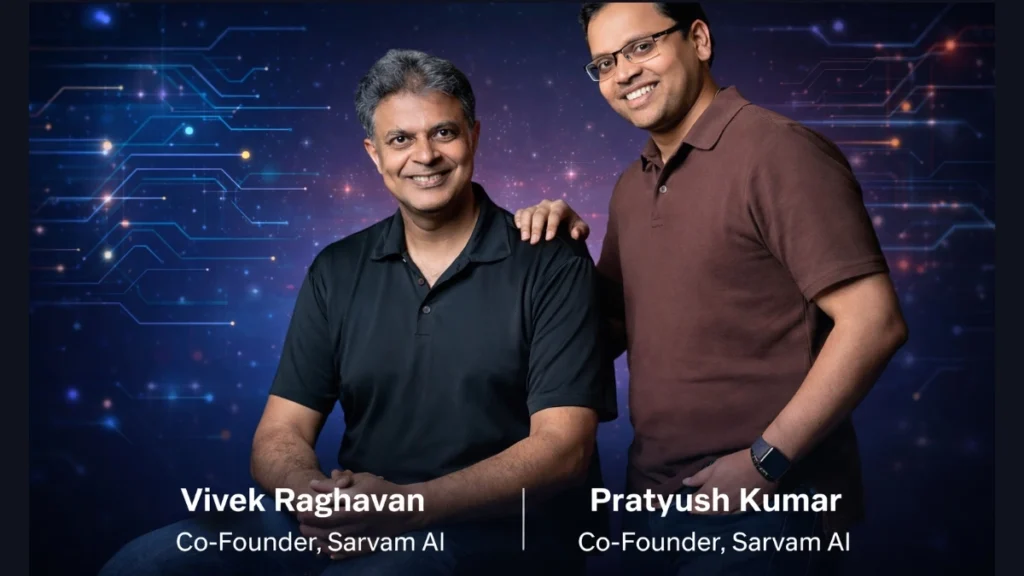
Dr. Vivek Raghavan and Dr. Pratyush Kumar co-founded Sarvam AI after years at the AI4Bharat research lab at IIT Madras, where they were quietly building open-source Indian language models when the VC world did not care and no funding was coming.
- Vivek Raghavan founded OpenHathi, one of the earliest serious open-source Hindi language models, and has been an active angel investor in the Indian tech ecosystem
- Pratyush Kumar built Padh.ai and AI4Bharat.org, spending his entire career focused on one problem: making AI genuinely work for Indian languages
These are not people who pivoted to AI because it became popular in 2023. They have been grinding at this specific problem for over a decade. That research depth is Sarvam’s biggest advantage and no amount of funding can replicate it quickly.
Funding and Valuation: The Numbers Behind the Vision
You will not believe the level of confidence investors showed in this project. They poured $41 million into Sarvam AI at a time when global startup funding had practically frozen. Nobody was writing big cheques in late 2023, yet three of the sharpest VC firms in the world decided Sarvam was worth the bet.
- Lightspeed Venture Partners led the round
- Peak XV Partners (formerly Sequoia India) backed them
- Khosla Ventures also came in
By 2025, total funding reached $53.8 million with a valuation of around $200 million. That gap between Sarvam and OpenAI’s $500 billion-plus valuation is enormous, yes. But for a two-year-old Indian AI lab building sovereign models from scratch, that number represents something real and serious.
Sarvam AI’s Models: How They Evolved
This is the part most articles skip, and it is the part that actually shows you how Sarvam thinks.
Sarvam-1: October 2024
Their first model had just 2 billion parameters, which sounds modest until you see it outperform Gemma-2-2B and Llama-3.2-3B on Indic language benchmarks including MMLU, Arc-Challenge, and IndicGenBench. A small model beating bigger ones because it was built for the right problem. That is the Sarvam philosophy in one result.
Sarvam-M: May 2025
The 24 billion parameter follow-up was built on Mistral’s French open-source foundation and delivered 86% better performance on tasks combining maths with romanised Indian language inputs. The community had one sharp question though: if the base is French, what exactly makes this sovereign? It was a fair challenge. Sarvam took it seriously and answered it with their next release.
Sarvam-30B and Sarvam-105B “Indus”: February 2026
This is where the story turns into something genuinely historic.
On 18 February 2026, at the India AI Impact Summit in New Delhi, Sarvam announced two models built entirely from scratch. No fine-tuning on existing open-source work. No borrowed Western foundation underneath.
- Sarvam-30B runs on a mixture-of-experts architecture, activating around 1 billion parameters per token with a 32,000-token context window
- Sarvam-105B, named “Indus” after India’s oldest civilisation, trained on 16 trillion tokens of data
Indian data. Indian compute. Indian model. That is not marketing language. That is a structural decision that changes what this technology actually is.
The Indus App: My Honest Experience
Let me be straight with you because I was genuinely skeptical walking into this.
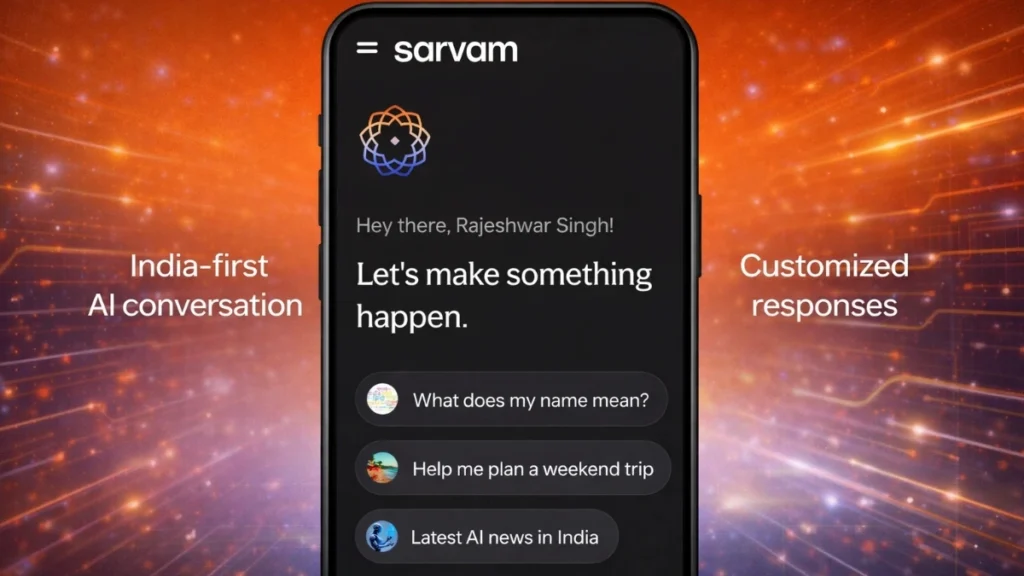
Every few months something gets called India’s ChatGPT and it turns out to be a rebranded API wrapper with a saffron colour palette. When I first opened the Indus App, I was fully prepared to be disappointed.
I was not disappointed.
After spending a week testing it in Hindi, switching to English mid-conversation, throwing Hinglish at it the way I actually speak, something stood out clearly. The app does not fumble when the language shifts. It does not return responses that smell like Google Translate had a hand in them. My native language inputs came back as real, flowing, contextually aware replies. That is not something I have experienced with ChatGPT on the same tasks.
Indus App Features:
- Multilingual Chat: Switch between Hindi, English, Tamil mid-conversation without losing context
- Voice Input: Speak naturally in your language, no typing needed
- Live Web Search: Real-time answers from the internet, not just stored training data
- Document Upload: Drop in a PDF or image and ask questions about what is inside
- In-App Document Writing: Write and edit notes directly within the app
How to Download the Indus App:
- Android: Search “Indus by Sarvam” on the Google Play Store
- iPhone: Search “Indus AI” on the Apple App Store
- Web: Visit indus.sarvam.ai from any browser
- Sign in with a phone number, Google account, or Apple ID
Current Limitations (Beta Phase):
- Chat history cannot be deleted without deleting your entire account
- Reasoning mode stays on permanently, which slows some responses
- A waitlist may appear depending on server load
- Knowledge cutoff is currently June 2025
These limitations are real and worth knowing. But for a beta product taking on a problem this size, the experience is far more solid than it had any right to be at this stage.
Sarvam AI vs ChatGPT: Side-by-Side Comparison
| Feature | Sarvam AI (Indus) | ChatGPT (GPT-4o) |
|---|---|---|
| Language Approach | Indian-languages-first | English-first |
| Hindi Accuracy | Native-level | Translation-based |
| Hinglish Support | Strong | Often struggles |
| General Intelligence | Good | Excellent |
| Indian Cultural Context | Built-in | Limited |
| Data Hosting | India (air-gapped for govt) | US servers |
| Live Web Search | Yes | Yes (Plus plan) |
| Voice Input | Yes | Yes |
| Pricing | Free (beta) | Free and paid tiers |
| Best For | Indian language tasks | General global tasks |
The honest read: if you live your digital life in English and need maximum raw AI capability, ChatGPT is still the stronger tool. But if your brain works in Hindi, you speak Hinglish naturally, or you have ever felt like these AI products were made for someone else, Indus feels built for you in a way nothing else currently does.
IndiaAI Mission: Why the Government Is Betting on Sarvam
This is the part that elevates Sarvam from startup story to national infrastructure story.
In April 2025, India’s Ministry of Electronics and Information Technology handed Sarvam AI one of the most significant mandates in Indian tech history: build the country’s sovereign Large Language Model. Not fine-tune an American one. Build it.
The IndiaAI Mission launched in March 2024 with an initial budget of Rs. 10,000 crore. Sarvam received access to thousands of GPUs for model training as part of this programme. Think of it the same way India treated its space programme, its nuclear programme, its defence manufacturing. When a technology becomes strategically critical, India builds it at home.
The UIDAI partnership is where this becomes genuinely massive in scale. Aadhaar services! the world’s largest biometric identity system covering over a billion Indians will now use Sarvam’s models for voice-based multilingual support. The entire AI stack sits on UIDAI’s air-gapped servers. No data leaves Indian infrastructure. Not one byte.
Sarvam AI’s Full Product Ecosystem
If you think Sarvam is just a chatbot company, you are looking at only one corner of what they are building.
- Saaras V3: Speech-to-text model that transcribes naturally spoken Indian languages with real accuracy
- Sarvam Vision: Reads documents and runs OCR on Indian scripts — yes, including handwritten Hindi content
- Text-to-Speech: Natural-sounding voice output across Indian languages, not the robotic synthesiser voice you are picturing
- Cross-language Translation: Tamil to Marathi, Gujarati to Bengali — not just English to Hindi
- Sarvam Kaze (Coming May 2026): AI-powered wearable glasses supporting over 10 Indian languages with real-time listening and comprehension built in
Who Is Already Using Sarvam AI?
The real test of any AI product is whether serious organisations are staking their customer experience on it.
Tata Capital embedded Sarvam’s multilingual AI into their consumer loan products so customers can have loan conversations in their own language, removing a barrier that quietly locked out millions of people.
UIDAI uses Sarvam’s models to deliver voice-based multilingual assistance across Aadhaar services, directly serving the crores of Indians who cannot read or type in English.
Education platforms are pulling Sarvam’s models into competitive exam preparation tools, making mathematical reasoning accessible in Hindi and regional languages for students who were previously underserved by English-only tools.
The Honest Limitations
Honest coverage means saying the uncomfortable parts too.
The funding gap is not small. $53.8 million total versus OpenAI’s $500 billion-plus valuation means the difference in compute power and research velocity is enormous. This is a real constraint, not a minor footnote.
Government dependence creates real risk. If political priorities shift, Sarvam’s access to training infrastructure shifts with them. That is a variable no startup wants its survival tied to.
The Indus app still needs work. Chat history issues, the always-on reasoning mode, and waitlist friction are genuine friction points for users right now.
Global benchmarks are unambiguous. On general intelligence tasks, GPT-4o and Gemini Ultra are still meaningfully ahead. Sarvam’s strength is specific and focused, which is also exactly why it matters for the use cases it targets.
My Final Take
After a week with the Indus App and a close look at everything Sarvam has built, here is where I honestly land.
If English is your working language and you need the most powerful general-purpose AI available today, use ChatGPT. That answer has not changed.
But if you have ever opened an AI tool, typed in Hindi, and felt like you were talking to something that fundamentally does not get you, try Indus before you write off Indian AI. It is free. It is live. And it surprised me in ways I was not prepared for.
Sarvam Ai is not a finished product. It is not going to eat OpenAI’s lunch next quarter. But it is the most technically credible, most genuinely India-first AI effort this country has ever produced, and the people building it have the research pedigree to back up that claim.
My recommendation: download it today, spend thirty minutes with it in your mother tongue, and judge it yourself. Real opinions come from real use, not from spec sheets.
Frequently Asked Questions (FAQs)
What does Sarvam AI do?
Sarvam AI builds large language models specifically for Indian languages. Their app Indus lets you chat, search the web, and upload documents in Hindi, Tamil, Gujarati, and 19 other Indian languages all without the robotic, translated feel you get from ChatGPT.
Who is the founder of Sarvam AI?
Dr. Vivek Raghavan and Dr. Pratyush Kumar founded Sarvam AI in 2023. Both come from the AI4Bharat research lab at IIT Madras and have spent over a decade building AI tools specifically for Indian languages.
Is Sarvam AI API free?
Sarvam AI offers a free tier for developers to test its API, including speech, translation, and text models. For production-level usage and higher call volumes, paid plans apply. You can check the latest pricing at sarvam.ai.
Is Sarvam AI any good?
For Indian language tasks, yes, it is genuinely impressive. It handles Hindi, Hinglish, and regional languages far more naturally than ChatGPT does. For general English tasks, GPT-4o still has the edge. But if you work in Indian languages daily, Sarvam AI feels like it was actually built for you.
Q5: How do I apply for jobs at Sarvam AI?
Visit sarvam.ai/careers for current openings. The company is actively hiring in AI research, NLP engineering, speech technology, and product roles.
Conclusion
Let me be direct with you, because I think this matters.
For years, every AI breakthrough has come from the US or China. India has been a consumer, not a creator. Every time you used an AI tool in Hindi, you were using something that treated your language as an afterthought, a translation layer bolted on after the real work was done in English.
Sarvam AI is the first serious attempt to change that at the foundation level. Not by wrapping a Western model. Not by localising an American product. By building from scratch, in India, with Indian data, for Indian users.
Is it perfect? No. Is the gap between Sarvam and OpenAI enormous? Absolutely. But the right question is not whether Sarvam can beat ChatGPT today. The right question is whether India should have its own AI infrastructure that it controls, that understands its people natively, and that does not send sensitive data to servers in another country.
The answer to that question seems obvious. And Sarvam AI is the most credible team India has ever had working on it.
Now I want to hear from you. Have you downloaded Indus yet? Did it feel different from ChatGPT when you used your native language? Drop your honest experience in the comments below. Your real-world feedback matters a lot more than any benchmark number.
Disclaimer: The information shared in this article is for educational and informational purposes only. All figures regarding Sarvam AI’s funding, valuation, and partnerships are based on public records and news reports, so please do not treat this as financial or investment advice. My feedback on the Indus App comes entirely from my personal testing and observations; since the platform is currently in its beta phase, features and performance may change over time. TechSikho.in is an independent tech blog and carries no official affiliation with Sarvam AI or MeitY. While I have made every effort to ensure all details are accurate as of 2026, I recommend checking their official website for the latest technical updates or official changes.
Also Read:
- Sam Altman Net Worth 2026: Age, Education & Best AI Coding Advice
- 8 Best AI Tools for Coding in 2026 | Beginner to Pro Guide
- I Tested Google Flow AI for 7 Days | Here’s My Honest Review 2026
- Aravind Srinivas Net Worth 2026: Success Story of India’s Youngest AI Billionaire
- The Complete ChatGPT Photo Editing Prompts That Will Instantly Upgrade Your Photos In 2026
- 6 Best Free AI Tool for Stock Market That Actually Work in 2026